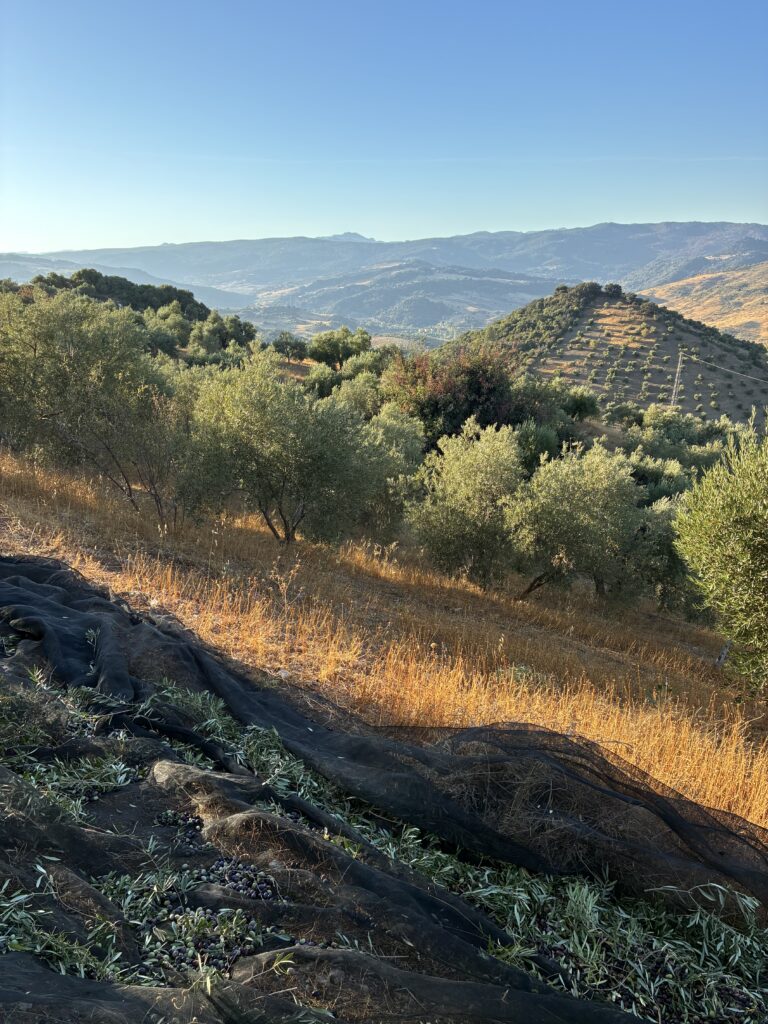
Every olive counted this year.
According to Greek myth, Aristaeus learned the art of olive growing from the nymphs and passed that knowledge on to people. He was also credited with teaching people how to press olives for oil.
I like the fact that this ancient story is about passing on skills. After our third olive harvest, I appreciate them a little more. You may own an olive tree, but that doesn’t mean you know how to get its fruit off the branches.
Four people, four days
Back in July, we could already see that this year’s crop would be small. Now we have the final figure: 1,200 kilos, roughly one-seventh of last year’s harvest. Remember how, in an earlier newsletter, I asked whose estimate would prove right — Joaquín’s or Simon’s? Now we know: Joaquín’s prediction of 1,000 kilos was closer. This time, he wins. As the harvest went on, it turned out his experience was worth trusting in other matters too.
There were four of us — Simon, Joaquín, Esteban and me — working in pairs. We started at eight in the morning. By midday, the sun was so strong that we had to stop for the day. Four hours may sound like a short working day, but our bodies thought otherwise.
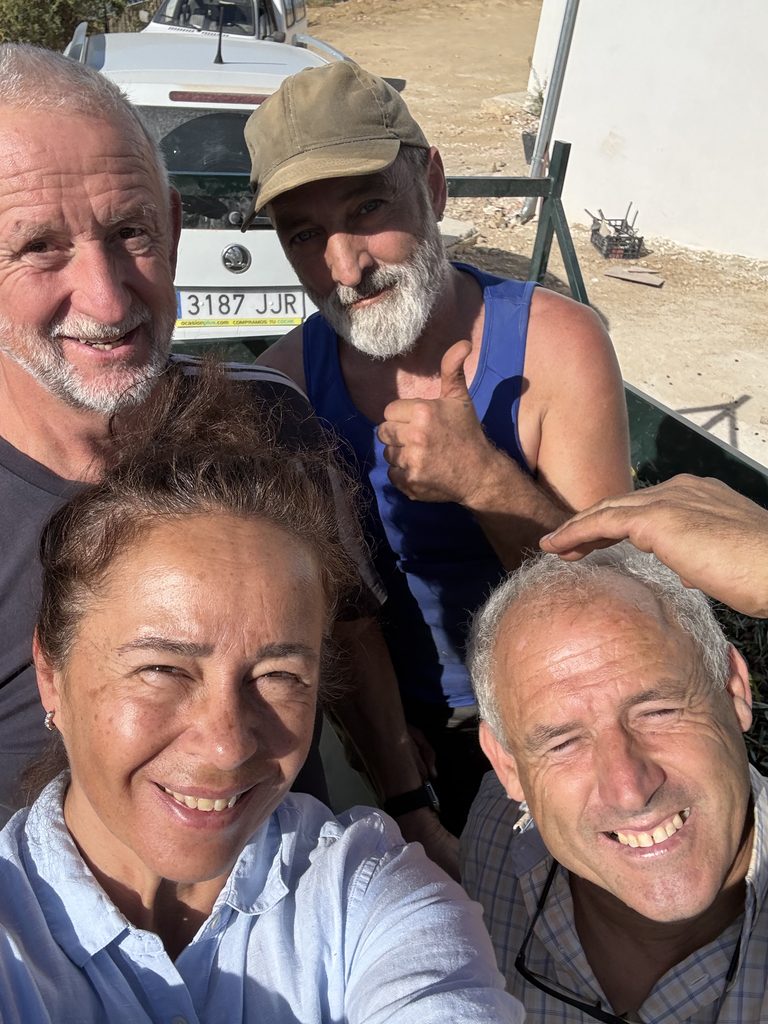
This year’s harvest team: Simon, me, Joaquín and Esteban.
Last year, a machine that shakes the tree trunk brought down most of the olives. We used long poles to knock the remaining fruit off the branches. With so few olives this year, using the machine didn’t make sense, so we had to bring them down with poles.
Early-harvest olives, however, hold on tightly to their branches.
Vareador — sounds like a toreador
Over the weekend, Simon and I harvested on our own, doing the best we could. Working alongside Joaquín and Esteban soon made it clear how much we still have to learn.
They were born here and have worked in their families’ olive groves, and other people’s too, since childhood. The long pole is called a vara in Spanish, and the person wielding it is a vareador. It sounds like a toreador. Joaquín and Esteban do the title justice. I’m still an apprentice.
In their hands, each stroke of the pole comes with a distinctive “whooosh”. Every movement is precise and practised: a strong, sharp stroke along the branches, rather than across them, to avoid breaking them. It looks easy when you’re watching. Then you pick up the pole yourself.
An entire science, as far as I’m concerned.
I really did try, but my “whooosh” needs a few more harvest seasons.
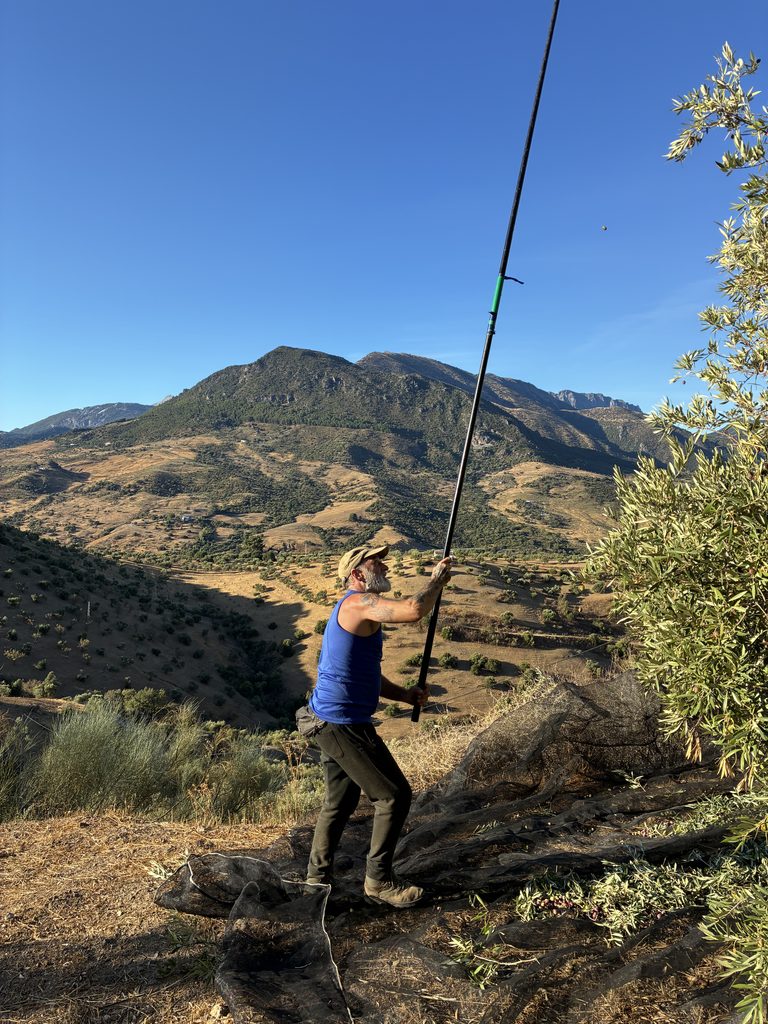
You can’t hear the proper “whooosh” in a photograph, but this is how it’s done.
Even laying out the nets is an art
With a small crop, a large share of your energy goes into spreading nets beneath the trees and moving them on to the next one. There are fewer olives, but you still have to work your way around the grove.
Working alongside Joaquín, I tried to be a good assistant and anticipate his next move. No such luck — he was already one step ahead, giving instructions while I was still rushing towards what I thought would be a useful place to stand.
Eventually, I realised I needed to watch first and understand the logic of the work. When do you use one net, and when do you need two? How do you arrange them on a slope? How do you drag a net to the next tree without leaving olives along the way? And how do you get the crop from the net into the sacks quickly, without losing any?
By the fourth day, things were beginning to make sense.
We learned a little more about the trees too. In our grove, the old trees bore more fruit this year than the younger ones — those under 25 years old. There were fewer olives on the branches, but more new shoots. Perhaps that’s a good sign for next year.
We took the harvested olives to the mill. A small crop has its complications here too: we need to gather at least the mill’s minimum batch quantity during the day. A few generous handfuls won’t quite do. As always, we’re having our olives milled below 27°C and leaving the oil unfiltered.
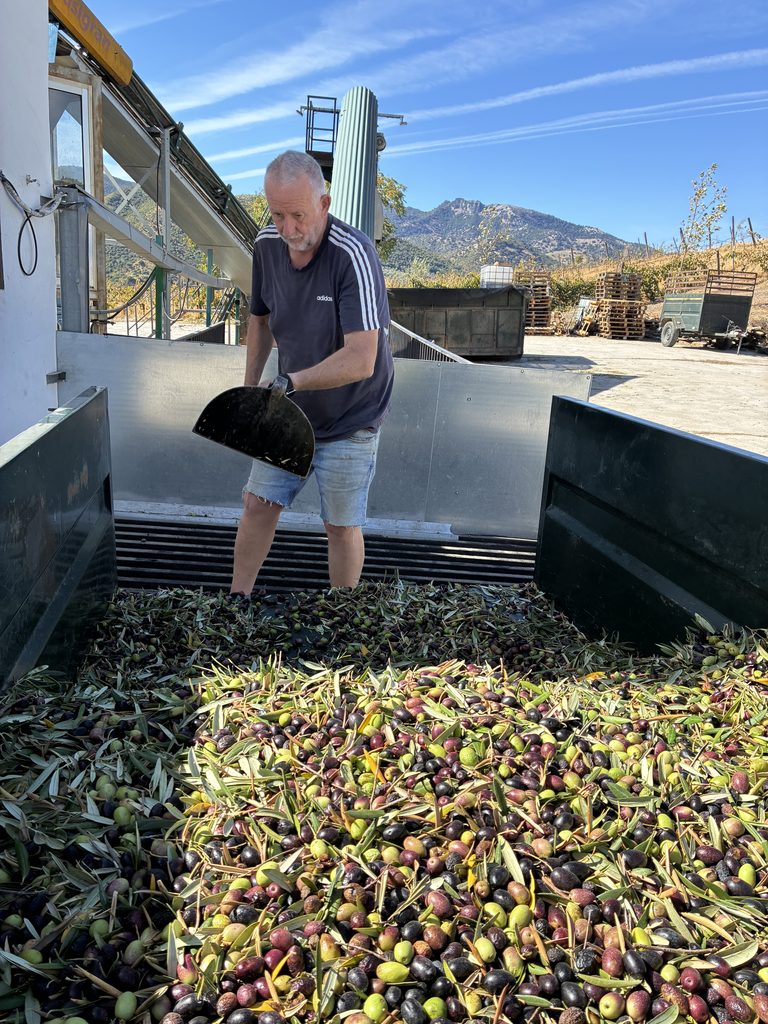
The crop reaches the mill. Even the last few olives have to come out of the trailer.
Our third harvest is now over. The crop was small, the physical effort considerable, and our respect for the skills of people who have done this all their lives grew even greater.
I wonder how the nymphs taught Aristaeus all these things. Next autumn, I’ll certainly need to be back beside Joaquín, learning.
And practising that proper “whooosh”.